Keep every project and agent session organized
Multitasking across projects gets messy fast. crystl keeps everything organized with gems, shards, and the crystal rail.
A gem is a project workspace in crystl: a directory on your machine with all its terminal sessions grouped together. The crystal rail is a glass bar on any screen edge that shows all your gems at a glance. Switch projects with a single click, even with dozens open.
Within each gem, shards are individual terminal sessions. Each shard runs its own shell and can run its own agent. Create isolated shards backed by git worktrees to keep concurrent in-repo edits in separate working directories. Agent sessions autosave and restore when you restart crystl, so you pick up right where you left off.
Why it matters
Project-scoped workspaces
Each gem groups every session for one project, so you never guess which terminal belongs where.
Tabbed sessions
shards are tabs inside a gem. Run several agents at once, each on its own task.
A hierarchy agents can read
Most terminals are a flat stack of windows. crystl nests shards in gems in your project, a structure your agents navigate by. You can still cd anywhere you want.
Signals at a glance
Per-gem icons and colors, per-shard crystal tints, and badges for approvals, merges, and file touches show what's happening and where without reading a log.
crystal rail navigation
A glass bar on any screen edge lists every gem. One click focuses that project; a second opens a fly-out with its agents' live status.
Session autosave & restore
Agent sessions save and restore across restarts, so you pick up where you left off. Close a shard by mistake? Resurrect it with Cmd+Shift+T.
shard-tab badges
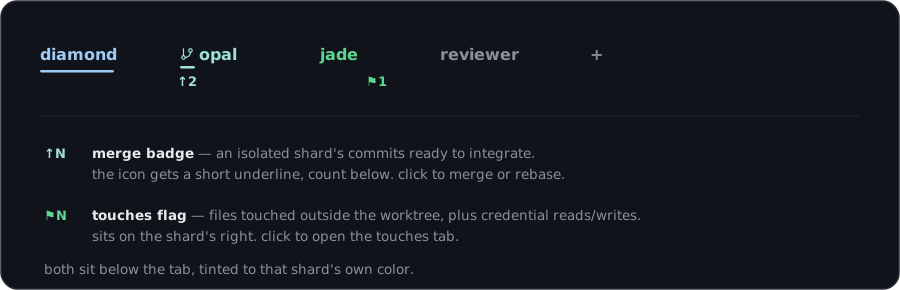
below a shard's tab, two small badges keep parallel work legible. ↑N counts an isolated shard's commits ready to merge; ⚑N flags files it touched outside its worktree, plus credential reads and writes. both are tinted to the shard's own color, and clicking either takes you straight to the action.
try it yourself
A free account and a download. macOS only, for now.
get startedgetting started guide →Frequently asked questions
- How many projects can I have open at once?
- As many as you like, on every plan including the free one. You're limited only by what your machine can comfortably run.
- Can I rearrange gems in the crystal rail?
- Yes. Drag gems to reorder them, and the Rail remembers your layout between sessions.
- What happens to my shards when I close a gem?
- Agent sessions autosave continuously. When you restart crystl, every session is restored exactly where you left off: context, conversation, and all. Closing a gem also saves the session history so you can browse past sessions any time.
- Can two gems point to the same directory?
- Yes. This can be useful for separate workspaces with different shard configurations for the same project.
- Does crystl only work with Claude Code?
- crystl is built around Claude Code, but it also has early support for OpenAI Codex. Features like approval cards rely on hooks that Claude Code provides.

Crystl's Book of Spells
Master crystl with a grimoire of powerful prompts. Summon heroes, assemble a party, revive shards, and complete epic quests.
open the book →More features
Floating Cards
See what every agent needs from you, the moment it needs it.
Agent Activity Panel
One live view of every agent across all your gems: who's working, who's idle, and where tokens are going.
Schedule Agents
Launch a fresh agent at a set time (once, daily, or weekdays). Pick the gem, agent, model, and prompt; crystl fires it on schedule.
Automation (Sequences)
Automate the work you keep doing by hand. Write the job down once and let a schedule, a file landing, or a watched URL run it for you.
Parallel Sessions
Run multiple Claude instances on the same repo in separate git worktrees.
Hero Shards
Summon a single hero as a shard (its own agent, model, and persona) without a quest party.
View Modes
Read a session as a terminal, as a conversation beside it, or as a conversation filling the window. The terminal keeps running either way.
History Navigator
Browse, jump through, and search every session: conversation and tool calls.
Token Tracking
Track token burn per shard, estimate turns left, and reclaim context window by disabling heavy plugins and skills.
Workbench
A slide-out task list in every project, backed by a WORKBENCH.md the agent reads and writes with you.
Markdown Editor
Render and edit any .md in a side panel. Toggle it from the workbench, and let agents open docs for you from the CLI.
Prompt Integration
Facet Inserts give you one-click access to saved prompts, commands, and shortcuts.
Agent File Editor
Create, edit, and manage CLAUDE.md, rules, skills, and agent config files with a block editor, file chooser, and project optimizer.
Project Optimizer
Scan your project for gaps in agent configuration (missing files, incomplete docs, oversized code, and setup issues) with one-click fixes.
Skills Library
Browse and import agentic skills that teach agents like Claude Code or Codex new tricks: code review, testing, deployment, and more.
cavrn terminal
The terminal as structured data: every turn, tool call, result, and table captured as agent-readable metadata. Drawn fast on the GPU with Metal.
Remote Development
Full crystl integration over SSH: approval cards, file relay, and click-to-open on remote machines.
Open Models
Run open models locally or hosted, orchestrate them with frontier agents, and cut token costs.
Agent Orchestration
One agent spawns, supervises, and merges the work of many: a control room for a team of coding agents.
crystl quest
Assemble a party of specialized agents. Each brings unique skills, coordinates in shared chat, and executes in parallel.
Screenshot Bar
Drag recent screenshots into the terminal. Spotlight-powered, always up to date.
Copy Bar
A one-click copy bar under the terminal. Agents stage text, you click Copy. Editable, up to 10 tabs, free.